
Harmony Trading System
DATA-DRIVEN TRADING • MACHINE LEARNING • AUTOMATION
Stop Guessing. Trade With Precision.
The Harmony Trading System is a culmination of years of research in volume and price action. Once alignment of price and volume present itself, the optimum trading conditions exists. It is a method that takes advantage of when volume and price are structurally moving in the same direction.
THIS MOMENT MATTERS MOST
Harmony Trading truly looks at volume and price action in a visual way so that you can SEE how the volume is internally moving without looking at 5 different indicators on 5 different screens.
Elements of the Harmony Trading System
A visual framework built around the interaction of price, volume, momentum, trend, and market structure.

Swift Harmony
A proprietary algorithm that calculates moment by moment alignment of blocks of contracts that are moving and closing in the same direction as price. The Dome ladder and volume depth are in synergy with price.
Full Harmony
Adds an additional algorithm that measures price breaking away from the range with increased volume & speed.
Shadow Trends
Measures expansion in momentum in the direction the market trends away from the middle of the range.
Aura Clouds
Representation of the averages moving in a direction. Gives me a clear idea if the market is going up, down, or sideways.
Trend Lines
Lets me know if the market is breaking above or below the most recent high/low and how we are progressing.
Consistency of the Harmony Trading System

Why is the Harmony System Consistent? Why is it going to help you, the trader, to be consistent in your trading?
The Harmony Trading system uses the same factors every single day and those factors haven’t change the entire time I’ve been using this system (10+ years). It always uses price and volume synergy…. One thing I had to give up is the idea that using support and resistance lines, pivot numbers, fibs, or many of the tools out there to make my decisions would add to the probability of success. Those ideas produce more confusion and lead you to ask more questions than they give answers.
Types of Trades Using the Harmony Trading System
The restored framework describes two primary trade concepts: Trigger trades that wait for a pullback and Spear trades that act when the Harmony elements align.
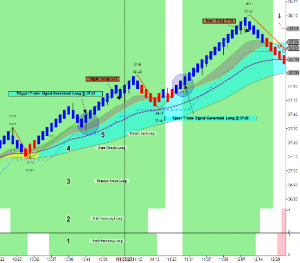
Trigger Long
1st – You must define your environment. This example is a Harmony trend in the long direction.
2nd – A Trigger Trade is a retracement trade. I am looking for a 2+ candle pull back in the direction of the harmony trend with a 1 candle reversal. This tells me the direction is holding and the buyers are in charge.
3rd – I place my order, then upon entry I look for my exit, which is a one candle reversal. In this case my exit created a quick 10 tic profit.
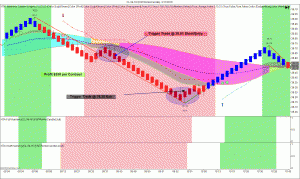
Trigger Short
What do we have working here?
We have the swift harmony, we have the full harmony, we have the shadow trend, and we have the aura cloud all on the short side.
Next we look for a 2+ candle pull back with a 1 candle reversal, which happens at the top of the move.
Now that we are in the trade, we are looking for a 1 candle reversal to exit the trade, which happens at the bottom of the move.

Spear Long
A spear trade is a little bit different than a trigger trade. The difference is I am not waiting for a pull back, the moment that all the elements are a go, I get into the trade.
Guess What? We still are using the exact 5 elements… Swift Harmony Signals
Full Harmony Signals
Shadow Trends
Aura Clouds
Trend Lines
Why take an immediate action (spear trade) instead of waiting for a pullback (trigger trade)? These are a break out trade and capitalizing on the run up insures more success.
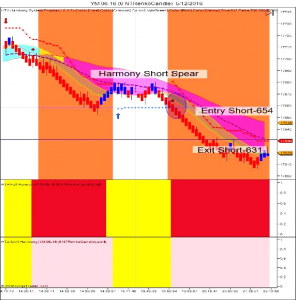
Spear Short
Same thing here…. Our approach NEVER changes. That is why we are consistent. Still looking for the exact same elements.
Full Harmony Signals
Shadow Trends
Aura Clouds
Trend Lines
Identifying Transitional Markets
The original page labeled this section “Identifying Transitional Markets.” Version 2 restores that descriptive heading.

The most important part about trading is to know when NOT to trade! You want to stay out of a Non-Directional market.
You can see with this example that 5 elements are not engaged at the same time. When the market is in harmony, you trade. When is not in harmony, you take a break until it gets back in harmony.
I can’t tell you how much of a relief it was for me to be able to identify a choppy market and not get caught up in the chop fest.
When in transition we Wait.
Trade With a Defined Framework
Explore the Harmony Trading System and learn how the framework organizes price, volume, trend, momentum, and trade execution.